
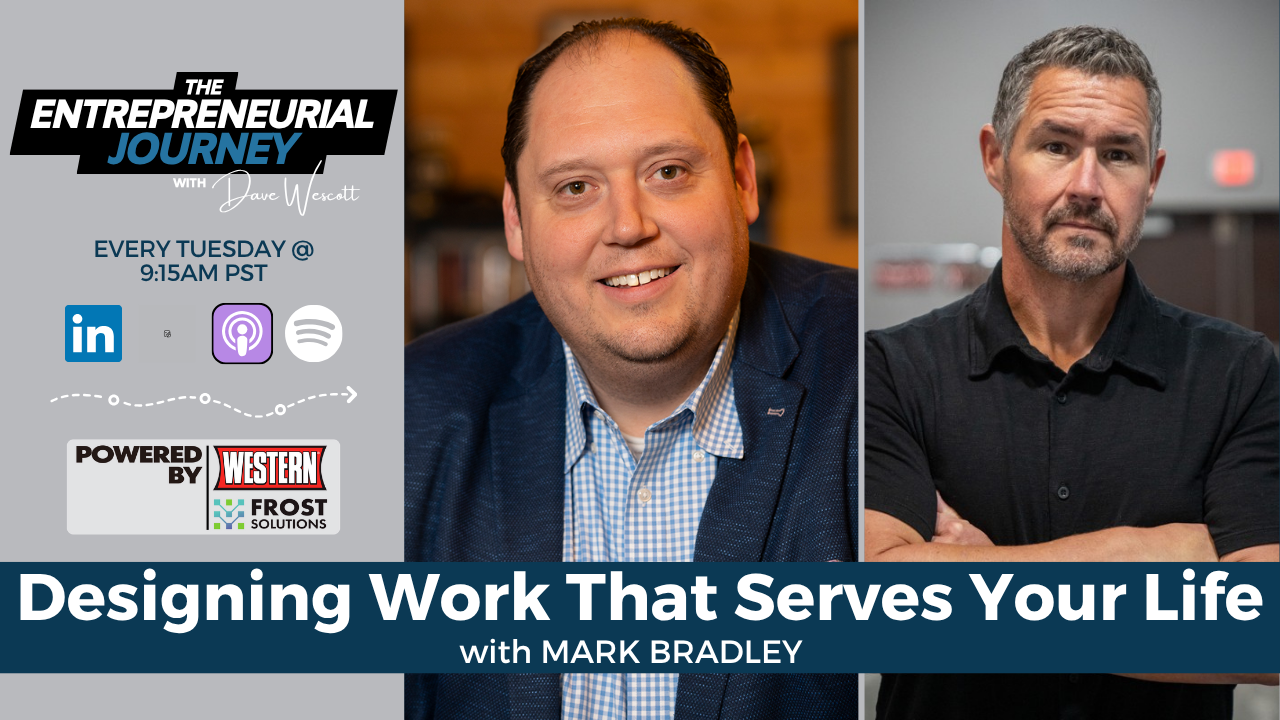
On this week’s podcast, I sat across from Mark Bradley — founder of LMN, chairman of LeanScaper, and one of the sharpest operators I’ve ever met.
But here’s the thing that struck me most about our conversation:
Mark didn’t come on The Entrepreneurial Journey to talk about software.
He came to talk about life design.
From snow shovels to software
Mark’s story starts far from Silicon Valley.
He was a steamfitter in a nuclear plant — the kind of job that teaches you discipline before it teaches you dreams. On the side, he started a small landscaping company. A few lawns, a few driveways.
Fast-forward a few years, and that “side hustle” had become a multimillion-dollar design-build firm. Then he built LMN — software that helped thousands of contractors run their businesses smarter.
Now, after stepping back from LMN, Mark’s pouring his energy into LeanScaper, a hybrid of community, mastermind, and workflow automation built for the trades.
But when we sat down to talk, what fascinated me wasn’t how Mark scaled businesses — it was how he rebuilt himself.
The cost of success
Mark told me something I’ll never forget:
“I probably screwed this up as bad or worse than most people I’ve met. I put business first for 15 years — and I lost almost everything else in the process.”
He wasn’t exaggerating.
Health gone. Marriage broken. Relationships strained.
He’d built the dream company but was living a nightmare schedule.
That kind of honesty — the kind that only comes after a few scars — is what I love most about these conversations.
Because every entrepreneur I know has been there in some way: chasing the next milestone, the next contract, the next “win,” while the rest of life starts to fade out of focus.
The integrated life
Somewhere along the way, Mark stopped chasing balance.
He started chasing integration.
He laid out his five goals — the compass for everything in his calendar:
1️⃣ Optimize mental and physical health.
2️⃣ Optimize his romantic relationship.
3️⃣ Optimize relationships with family, friends, team, and community.
4️⃣ Keep learning — always.
5️⃣ Then, optimize business.
That order isn’t random. It’s intentional.
And here’s what hit me: Mark didn’t just say those goals — he time-blocked them. He literally designed his life around what mattered most.
He built a calendar that reflected his values.
Every week, he revisits it. Every quarter, he adjusts it. Every day, he lives it.
That’s integration.
The system behind the soul
Even as Mark talked about purpose and faith, he circled back to structure — to leading with metrics, not emotion.
He coaches entrepreneurs to create measurable goals for themselves and their teams, so progress can be celebrated, not just survived.
Because when everything’s emotional, leadership becomes reactive.
When it’s structured, it becomes sustainable .
That balance — systems with soul — might just be the sweet spot of modern entrepreneurship.
What I took away
When we wrapped up the episode, I kept thinking about how often we, as founders, design our businesses but rarely design our lives.
We’ll map out org charts, growth plans, and software stacks — but we won’t map out a year that includes rest, health, or time with our families.
Mark reminded me that we don’t need to separate those things.
We can build them together.
Because success that costs you your health, your marriage, or your peace isn’t success — it’s debt.
And the only way to pay it off is with purpose.
Takeaway
If you’re tired of chasing balance, maybe it’s time to start building integration.
Pull out your calendar.
Block time for your body, your relationships, your faith, your learning — before your business meetings fill the page.
Design the life you actually want to live.
Then build the business that fits inside it.
🎧 Listen to the full conversation with Mark Bradley on The Entrepreneurial Journey Podcast.
It’s not just about landscaping. It’s about life-scaping — designing a life you don’t need a vacation from.
Leave a Reply